
Pluto in Aquarius and the Structure of Mini Ice Ages | The Universe Always Cools Things Down Before a Reboot
A speculative reading of climate cycles, mini ice ages, and historical resets through the lens of Pluto in Aquarius—where science ends, symbolism begins, and cold may mark the threshold of a new era.


“New study: Earth’s natural orbital cycles point to the next ice age in about 10,000 years.”
That X post was the starting point for this essay.
At first glance, it sounds dramatic. But it is not pure fantasy. A university release discussing a 2025 Science paper explained that, by comparing the sequence of glacial and interglacial periods over the last million years with changes in Earth’s orbit, one possible reading is that—under natural conditions alone—the next major glacial phase would begin in roughly 10,000 years.
At the same time, another 2025 Earth system modeling study suggested a very different timeline, putting the next glacial onset closer to 50,000 years away under natural conditions.
So the “10,000 years” claim should not be treated as a single, settled truth. It is one serious interpretation among several. But the larger point remains important: if we temporarily set aside anthropogenic greenhouse gases, Earth’s natural orbital cycles seem to point, over the long term, toward cooling rather than indefinite warming.
The scientific framework behind this is the Milankovitch cycle.
Earth’s climate is strongly shaped by long-term changes in:
- eccentricity (how circular or elliptical Earth’s orbit is),
- axial tilt (how much Earth leans),
- and precession (the slow wobble of Earth’s axis).
These orbital shifts change how solar energy is distributed across the planet over tens of thousands to hundreds of thousands of years.
And where are we now?
At present, Earth is still inside the larger Quaternary ice age that began around 2.6 million years ago. What we are living in now is the Holocene, the current interglacial period, which began about 11,700 years ago after the last major glacial phase ended.
In other words, we are not living outside an ice age altogether.
We are living in a relatively warm interval within a much larger ice age system.
Even During an Interglacial, the Earth Can Still Cool
This is the key point:
Being in an interglacial period does not mean Earth must remain steadily warm.
Interglacials are comparatively warm phases between colder glacial periods, but even within them, temporary cooling can occur over decades or centuries.
This is where the idea of the Little Ice Age—or, more broadly, mini ice age–like cooling episodes—comes in.
These are not full glacial ages. They are more regional or hemispheric cooling events, often most visible around the North Atlantic and the Northern Hemisphere. The most famous case is the long cool interval usually associated with the Little Ice Age, often dated broadly from the early 14th century to the mid-19th century.
Its causes are not thought to be singular. Instead, scholars usually point to a mix of:
- volcanic activity,
- reduced solar activity,
- atmospheric circulation shifts,
- and ocean circulation changes.
A well-known example is the Maunder Minimum, the long solar minimum from roughly 1645 to 1715.
This period overlaps with part of the Little Ice Age, but it would be too simple to explain the entire Little Ice Age through solar decline alone. Even if a similar prolonged solar minimum occurred today, it would not fully cancel modern warming. At most, it might soften it somewhat.
So yes, cooling can happen—but its mechanisms are complex.
Another major issue today is the AMOC, the Atlantic Meridional Overturning Circulation.
This large Atlantic circulation system carries warm surface water northward and cold deep water southward. Because of warming and freshwater input from Greenland ice melt, scientists expect it to weaken in the 21st century. Some recent studies have intensified discussion around possible tipping points, though a full shutdown within this century remains uncertain.
Even so, AMOC remains one of the most important scientific discussions when it comes to scenarios of regional or localized cooling.
And for short-term cooling events, we cannot ignore volcanic winter.
After the 1815 eruption of Mount Tambora, the following year—1816—became known as “the year without a summer.” Volcanic ash and sulfate aerosols in the stratosphere reduced sunlight, lowered temperatures across parts of the Northern Hemisphere, and caused major agricultural and social disruption.
So even in an interglacial world, Earth can still, at times, freeze locally and temporarily.
Up to this point, we are still talking about Earth science.
Now comes the real focus of this essay.
The Astrological Lens
Science explains mini ice ages and cooling events through orbital variation, volcanism, solar activity, and ocean circulation.
Astrology, however, asks a different question:
What kinds of structural transitions in human civilization tend to appear at the same time?
That is where Pluto in Aquarius becomes interesting.
In astrology, Pluto symbolizes:
- destruction and regeneration,
- the excavation of what lies beneath the surface,
- and the process of breaking down what has become corrupted, rigid, or exhausted, so that something new can emerge.
Aquarius symbolizes:
- intellect,
- networks,
- decentralization,
- reform,
- future orientation,
- and movement away from established order.
Pluto entered Aquarius for its long stay in late 2024 and is expected to remain there into the early 2040s.
The previous Pluto in Aquarius era that is most often cited is the late 18th century.
That period gave us:
- the American Revolution,
- and the French Revolution.
Ancient political structures cracked open.
Citizenship, rights, representation, and new forms of collective identity began to take shape.
Astrologically, it is a clear example of Capricornian order breaking apart into Aquarian reorganization.
This is why some astrologers describe our own moment as the biggest structural turn “since the mid-Edo period” or “since the late 18th century”: the 240–250 year cycle is here again.
To be clear, I am not arguing that Pluto causes climate cooling in a scientific sense.
That is not the claim.
What I am interested in is something more symbolic and structural:
Moments when social order breaks down and reorganizes seem, at times, to appear close to periods when climate itself “cools” and forces human systems to stop, strain, or reset.
What happens if we look at that overlap through astrology?
Placing Mini Ice Age Timing Beside Pluto in Aquarius
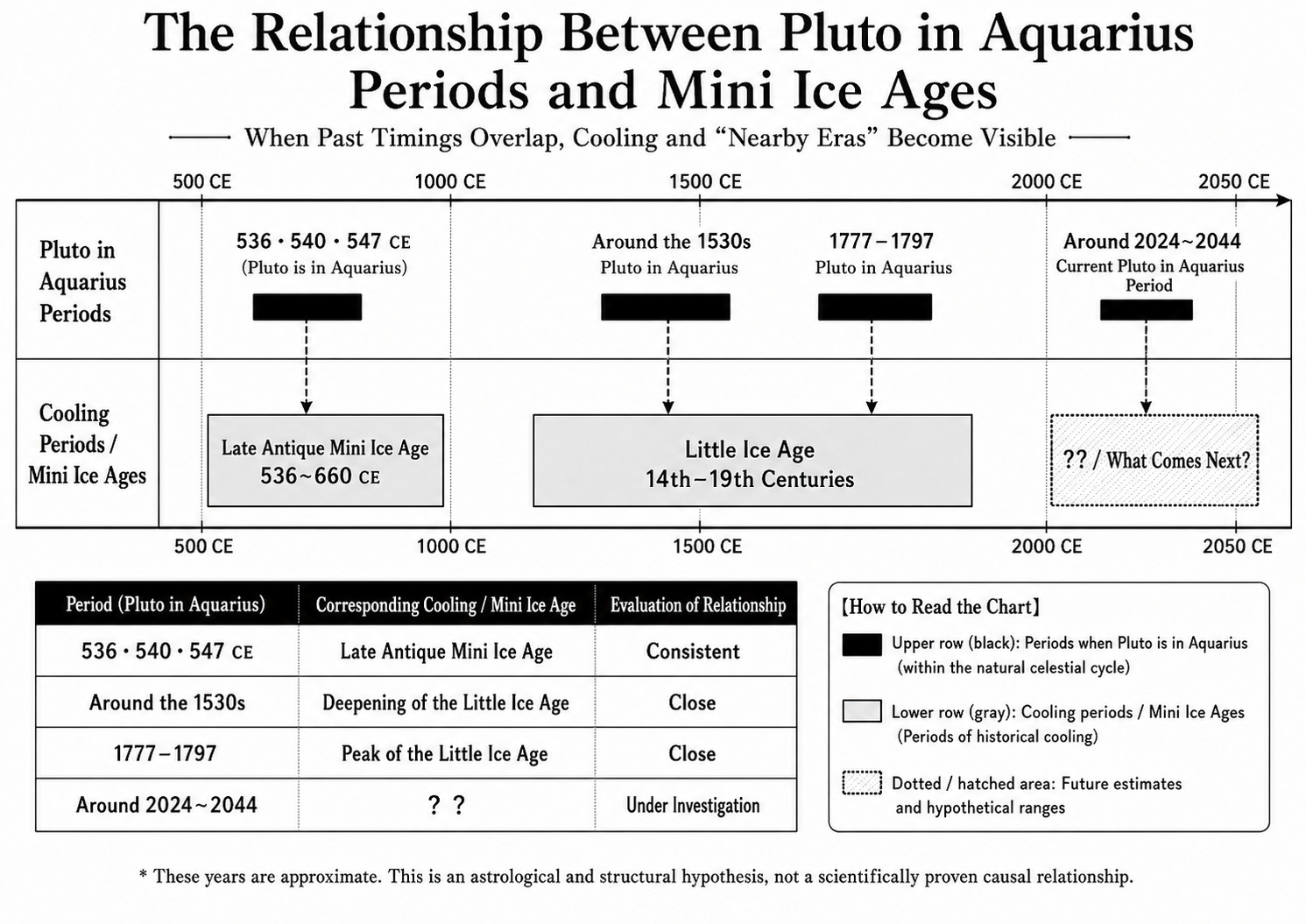
1. The Early to Mid-16th Century: Reformation and the Deepening of the Little Ice Age
If we move backward roughly 248 years from the late-18th-century Pluto in Aquarius era, we land in the early to mid-16th century.
In Europe, this was the age of the Reformation.
This was a period when established church authority fractured, and personal faith, interpretation, and conscience moved forward in new ways.
Astrologically, that is profoundly Aquarian:
- the weakening of centralized authority,
- the rise of distributed interpretation,
- and the transfer of spiritual legitimacy from institution to individual consciousness.
At the same time, Europe was also deep within the broader Little Ice Age.
The Little Ice Age itself stretched across several centuries, but the 16th and 17th centuries were especially important phases of cooling in northern Europe.
So here, once again, we see:
- religious and social restructuring
- alongside
- a visibly colder climatic regime
The overlap is difficult not to notice.
2. After 536 CE: “The Worst Year” and the Late Antique Little Ice Age
An even more striking case begins in 536 CE.
That year is now widely discussed in connection with what researchers call the Late Antique Little Ice Age.
A 2016 study proposed that after a cluster of major volcanic eruptions in 536, 540, and 547, the Northern Hemisphere entered a prolonged cool phase lasting until around 660.
This cooling overlapped with the Justinianic Plague, beginning in 541, and with the slow collapse of what remained of the ancient Mediterranean world.
So once again, cooling appears beside civilizational transition.
A colder atmosphere.
A more fragile system.
An old order beginning to fail.
I do not want to claim here that “536 was exactly Pluto in Aquarius” in some rigidly literal sense.
Applying Pluto’s 248-year cycle mechanically all the way back into late antiquity is obviously bold, and this essay is not about pretending that strict astronomical equivalence has been proven.
What I am looking at is something looser but, to me, still meaningful:
Does the same structural pattern keep appearing?
Does cooling, at certain moments, seem to arrive near periods of Pluto-in-Aquarius-style social reorganization?
That is the question.
So What Is the Actual Point?
The point is surprisingly simple.
1. Earth’s long-term natural climate cycles may still, under natural conditions, point toward eventual cooling.
2. Even within an interglacial, mini ice age–like cooling events can occur through volcanic, solar, or oceanic disruptions.
3. And when history is viewed through an astrological lens, periods near Pluto in Aquarius often seem to coincide with moments of both cooling and structural reset.
Science can responsibly say the first two things in varying degrees.
Science cannot say:
- “Pluto causes cold spells,”
- or “2026 will definitely bring a mini ice age.”
That would be a misuse of both science and astrology.
But as an astrological structural hypothesis, I think the following is worth considering:
Pluto in Aquarius may correspond to eras in which old material civilizations and power structures are first cooled, slowed, or interrupted—so that humanity can be forced into a new phase of intelligence, networks, and redesigned systems.
Capricorn is earth:
- structure,
- institutions,
- authority,
- accumulation,
- material form.
Aquarius is air:
- intellect,
- information,
- networks,
- decentralization,
- sharing.
What becomes oversized in Capricorn cannot always pass directly into Aquarius.
Sometimes it has to be cooled first.
Stopped first.
Interrupted first.
Only after that pause can a new circuit begin.
Seen that way, cooling is not merely catastrophe.
It becomes a kind of compression phase before a civilizational reboot.
Where Are We Standing in 2026?
By late 2024, Pluto had entered Aquarius for its full long-term passage.
At the same time, Earth system science is telling us several things at once:
- One line of research suggests the next natural glacial phase might begin in about 10,000 years.
- Another model places that farther out, at roughly 50,000 years.
- Anthropogenic greenhouse gases have already altered the natural climate trajectory.
- Regional cooling scenarios linked to AMOC weakening remain serious scientific questions.
So no—I am not saying a mini ice age is about to begin immediately.
But I also no longer find the theme of cooling easy to dismiss as a mere fantasy.
In fact, our era may be defined by a deeply Aquarian-Plutonian contradiction:
a warming world that may still contain regional or structural forms of cooling.
The whole heats up.
But certain systems stall.
Material civilization overheats.
But certain currents—social, institutional, relational, even oceanic—may cool, slow, and reorganize.
That tension, that asymmetry, that strange split between acceleration and interruption—
it may be one of the deepest signatures of the age we are now entering.
Cooling May Not Be the End—It May Be the Switch
If this hypothesis is even partly right, then “cooling” may not mean ending.
It may mean:
- pausing,
- compressing,
- and switching states.
History shows us again and again:
- After late antique cooling came the medieval world.
- After the Little Ice Age and plague came the conditions for the Renaissance.
- After the upheavals of the Reformation came new languages of belief, knowledge, and order.
The universe does not always allow a system to keep running in thermal overload.
Sometimes it cools it down.
Lets it stop.
And only then allows it to restart.
If so, then whatever “cooling” we experience after 2026—literal, symbolic, social, or personal—may not be here only to end things.
It may also be here to prepare what comes next.
So if there is some part of your own life that feels cold right now—
stalled, silent, unresponsive, stripped of warmth—
perhaps that is not only a sign of loss.
Perhaps it is the pause before a new circuit comes online.
That is one way I am reading Pluto in Aquarius.
Note:
This essay does not treat Earth science and astrology as interchangeable systems. The “next ice age in about 10,000 years” framing itself remains debated across studies, and any connection drawn here between climate patterns and Pluto’s cycle is offered only as an astrological and structural hypothesis, not as a scientific claim. I hope it can be read in that spirit: as an attempt to think about historical rupture, symbolic repetition, and the strange ways cycles may echo across different languages of meaning.